
How to eat grits
by AUDREY SHIPP
in Fall 2025
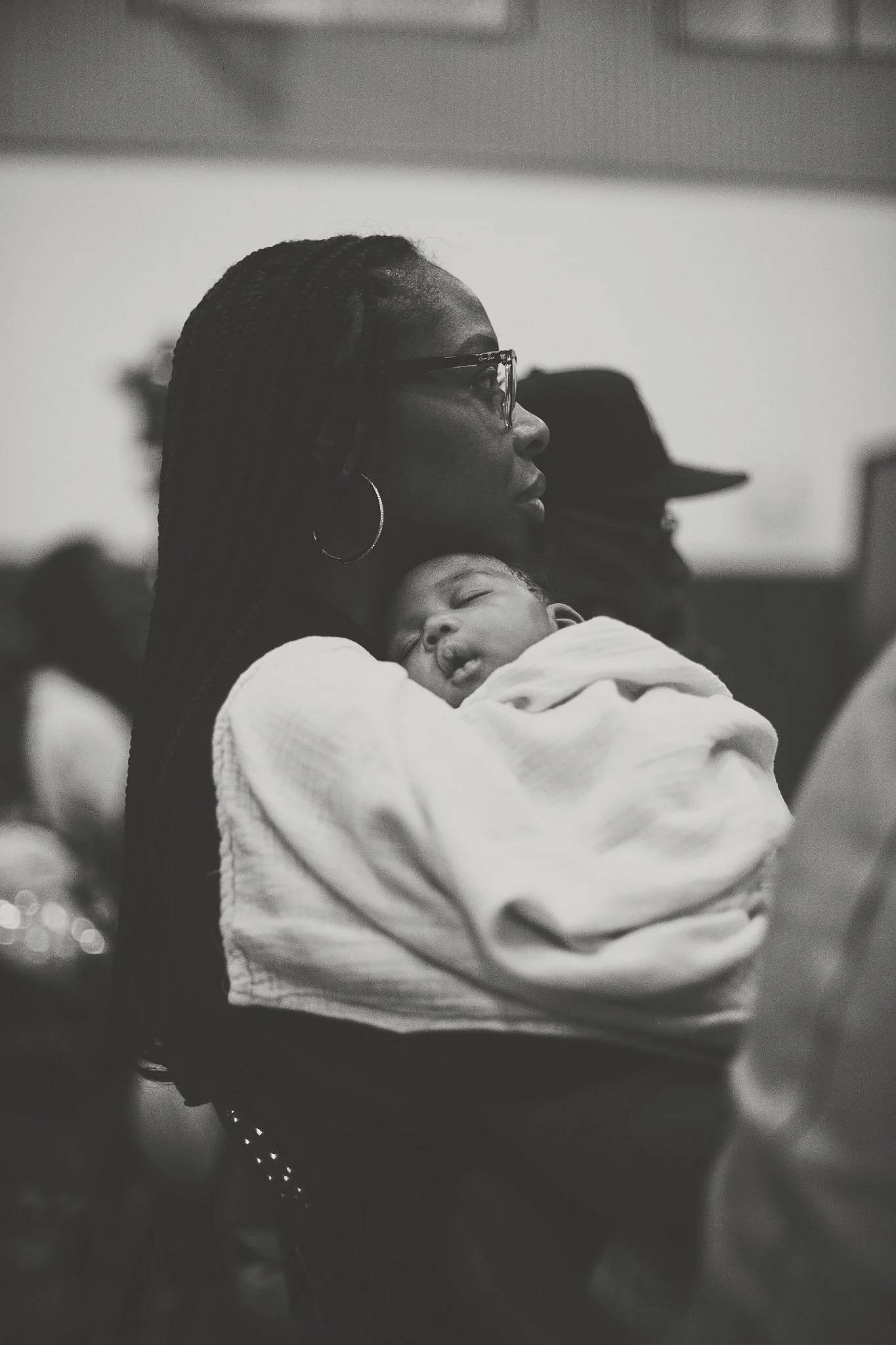
Tafari Melisizwe, “Black Mother and Child,” 2023
Life demanded that my sister and I eat weekday breakfasts of cold cereal before school, but we often enjoyed traditional weekend meals that stretched out time ensuring family experience remain in our memory.
On a Saturday morning that didn’t require weekday rushing, Grandmom wore her thin, pale pink house robe with a pajama dress underneath. Her brown legs displayed a sprinkled patchwork of dark moles beneath the robe. Her hair was tied in a rust-colored scarf, darker than her brown skin.
I sat on the kitchen stool and watched as she stood in front of the stove pouring dry grits into a small pot with boiling water. At six years old, my legs didn’t reach the floor. My ten-year-old sister stood nearby in the home we lived in with just Grandmom and our step-grandfather, Hayden.
“One of y’all hand me that large spoon,” Grandmom said as she looked over her right shoulder towards the spoon in the dishrack. My sister stepped forward, but I darted across the yellow linoleum floor towards the kitchen counter, grabbed a small spoon, and handed it to her.
“Not that one, gal. Lord, these grits are gonna get lumpy,” she said frowning.
“Oops,” I said, as I turned to replace the small spoon and exchange it for a larger one.
Grandmom took the large spoon. I stood near the stove and watched as she continued pouring the dry grits slowly from the box that shouted, “Quick 5-Minute.” She stirred the mixture in the small pot, and the boiling water hissed in stubborn acceptance. Since Hayden had already left for his job at the liquor store and wouldn’t be home to put a hurt on the grits, Grandmom was preparing just enough for the three of us.
She stirred, knowing this handwork was essential to avoid the clumps and lumps that can turn a bowl of grits into the worst. If too much mixture is added, the result will be a thick paste. Yet if not enough of the dry mixture is added to the hot water, the result will be a watery mess. The large spoon scraped the pot. As Grandmom stirred, the boiling water churned and burst. The mixture slowly shifted from mostly hot water to mostly hot white corn meal.
Next, Grandmom prepared scrambled eggs while the grits thickened. She warmed her black wrought iron skillet with a slim covering of melted butter, then cracked the eggs on the skillet’s edge. They sizzled in the buttery heat. Using a fork, she scrambled and stirred.
“Ok, girls, time to eat!”
I picked up a glass plate from the kitchen counter. “I’m first!”
“Heah, wait for me,” my sister said, as she picked up her plate.
I held the plate to my grandmother who filled it with spoonfuls of hot grits and a nice portion of scrambled eggs.
Our plates ready and steaming from the hot ingredients, we both hurried to the breakfast room adjacent to the kitchen. The breakfast room had a circular configuration with four windows, each teasing the morning sunlight; some more than others because of the lemon tree in the backyard. The challenge for me and my sister was to eat the grits— a food that holds intense heat then cools rapidly—while they were still hot.
Once seated, I slid the butter dish towards me across the glass table and readied myself to slice a portion of the butter stick.
“Who’s in there draggin’ that dish on the table?” Grandmom said from the kitchen.
“See,” my sister stared at me. “It’s Audrey.”
“Gal, what I tell you?”
“Sorry,” I answered. I stirred the butter and scrambled eggs into my grits, then added salt and pepper. I ate a forkful and savored the flavors and textures. The contradictory smooth grittiness of the grits, the richness of the scrambled eggs and butter, the suggestive spiciness of the salt and pepper. Each forkful was delicious.
My sister, meantime, maintained her grits and eggs in separate piles as she ate. Grandmom did the same as she sat on the kitchen stool.
As I was then learning, folks bring their distinct style to grits. Some eat them with just butter and some, with butter and sugar. Others eat them with cheese or with shrimp. They taste like white cornmeal, but their taste is more a hint than a certainty. Because of the bland taste, butter, salt, and pepper are important to wake up the flavor. The scrambled eggs add a rougher texture to the too-smooth grits. They also work in conjunction with the butter to create a rich flavor. Like the difference between angel food cake and pound cake—that is what butter and eggs can do to a serving of grits.
Years later, I realized grits are a cousin to many foods. Maize or maiz is an Aztec food that originated in Mexico. Although I was born in Los Angeles, my family’s origins trace back centuries to Africa. Portuguese slave traders did business in the Black enslaved and in corn as well. Their slave ships, sickening and despicably tight, arrived in the Americas filled with human cargo, then returned to the African coast laden with corn, tomatoes, and chocolate.
It's amazing how many dishes were created from this one staple food. Hot water cornbread is another Southern standard. Unlike yellow cornbread which is baked, hot water cornbread is made with white corn meal and fried in a skillet. Once it is fried, butter is added on top or inside the thin middle. Called bread, it tastes like fried grits. Other foods made from white corn meal that can be considered distant relatives to grits are Central American tamales made with white corn meal (masa) and arepas from Venezuela and Colombia. Arepas are like hot water corn bread with cheese and meat stuffed inside.
On that Saturday morning, I wasn’t thinking about the international reach of corn. For me, grits were simply a Southern food that I inherited from my grandmother and father, both of whom were born in Memphis, Tennessee. Of course, my Chicago-born mother cooked grits, but she did so sparingly. Grandmom, with whom I lived from ages five to twelve, was the Southern chef who prepared this food the most. And more importantly, she was the person who allowed me and my sister to experiment with it and find the exact combination that fit our palates.
The fit perfect, I finished my plate without burning my mouth, but also before the grits cooled into a stiff despicableness. Grandmom, my sister, corn, the South. I felt at home in Grandmom’s house.
Audrey Shipp is an AWP Writer to Writer mentee and a PEN America Emerging Voices Workshop LA honoree who is working on a hybrid memoir about writing and (un)writing in Los Angeles. Her writing has been published in various literary journals including Good River Review, Another Chicago Magazine, Litro USA, A Gathering Together, and Américas Review. She has English degrees from both UCLA and Cal State LA. Her professional life has been dedicated to teaching English and ESL in public high schools in Los Angeles. You can find her at AudreyShipp.net and on instagram at audreyshipp_adrianawrites.


