
The Book of Loretta
by AL-LATEEF FARMER
in Spring 2026
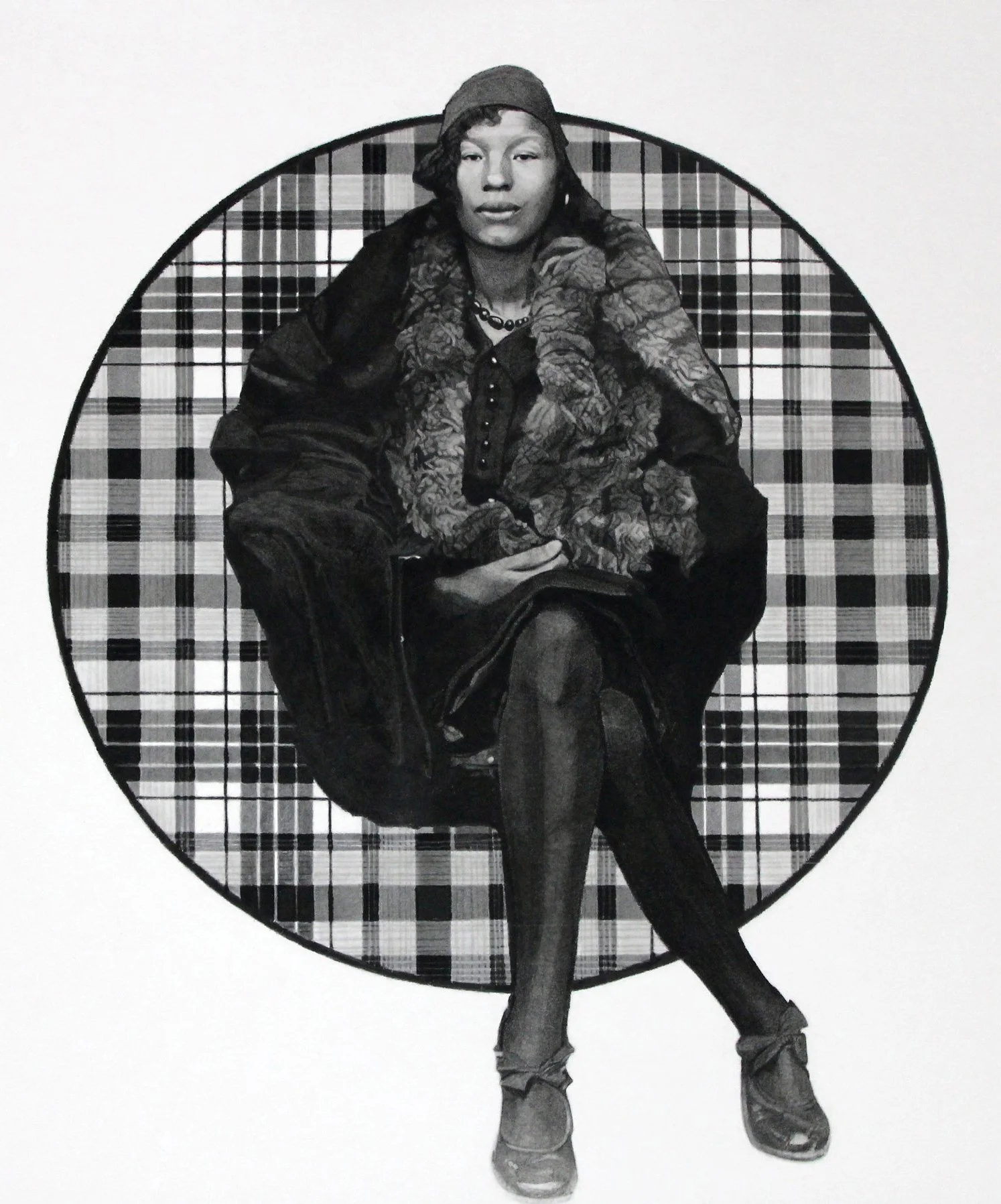
Neville Barbour II, “You Remind Me,” 2021
The morning sun slipped through the blinds. Loretta Johnson motioned for George to close them a bit tighter, but the light still shone in her eyes. She remembered then that George wasn’t with her any longer, and she wasn’t home. She listened to the beeps from the machines over her right shoulder, the nurses changing shifts, and the low moans of pain from someone down the hall. She hadn’t asked for pain meds yet. Not because the pain wasn’t there, but because she needed to be alert, hear what the doctors said, and learn the faces that came in and out.
She needed to feel alive.
Loretta had spent her adult life making sure she created space in rooms for people to be seen. She remembered birthdays, those who’d lost their mother, favorite scriptures, court dates, the way people like their mac and cheese. Now, she had to press a button to make sure people remembered she was alive.
7:26 a.m.
Tanesha. She was the nurse on duty when she was admitted on Tuesday. It was the end of her shift, but she stayed a little longer to make sure she was settled. Loretta hoped she would see her again, especially since the nurse from the previous day wasn’t as good. It took her three sticks to find a vein for her IV. Tanesha got it in one. And it didn’t hurt.
“Did you sleep okay, Ms. Loretta?”
She was checking her chart and deflating the blood pressure cuff to get a reading.
“I’m an old woman, child. I sleep with one eye on my purse, the other on the sparrow.”
Tanesha stopped and stared at Loretta. She reminded her of her grandmother, especially towards the end.
“Well, your numbers are better than when you came here. Would you like breakfast? Maybe oatmeal?”
“You got any brown sugar in your purse? And tell them to use butter. Not that margarine. Ain’t no way none of us down in that kitchen.”
Tanesha hid her smile.
“I’ll see what I can do about the brown sugar. Your numbers are better. But not butter-in-your-food-better.”
“Where are you from, precious?”
“I grew up in Bellewood.”
Loretta sucked her teeth.
“That’s where Black folks move when they get twenty dollars more than their neighbor.”
Tanesha laughed.
“Yeah, my mom landed a decent job out of college and moved there. She’s from here, though. Went to Roosevelt.”
“It ain’t been called Roosevelt in a long time. What’s your mother’s name?”
“Charlene Rhodes.”
Loretta thought for a few moments.
“Dark skinned, gap teeth?”
Tanesha smiled and nodded.
“That girl had horrible taste in boys. I hope your daddy changed all that?”
“I think he did. They’ve been married for 28 years now. You worked at the high school?”
“Worked all over the district. Spent 15 years at the high school.”
“You were a teacher?”
“I was a teacher, a hall monitor, lunch lady when they went on strike, relationship advisor, guidance counselor for the kids they ignored, and a mother to those who needed one when theirs were working overtime. They’ll say I was an educator when I’m gone. I say I just loved people until they realized they were worth loving.”
“Wow. I know you have some stories.”
“Child, I can write a book. Maybe two.”
Loretta looked to the door as if the answer would come in wearing a suit, or scrubs, or even a pair of worn out work boots, but the doorway was empty.
“You have any children, Ms. Loretta?”
“I didn’t carry any children, but I’ve got plenty.”
“My mother always talks about women like you. Calls them ‘unsung’. She say they do all the heavy lifting, and no one ever gives them anything but a plaque and cheap flowers.”
“Plaques collect dust and flowers die. People are supposed to be remembered.”
Loretta smiled at herself after Tanesha told her she had to check on her other patients. She felt good to know that her nurse came from a young woman she had a hand in helping along the way. Avery Heights used to be that kind of place; you were never one or two people away from someone you prayed for.
9:15 a.m.
She was nodding off when she heard a knock at the door. She was hoping it was the nurse. She wanted to thank her for the brown sugar, but it was Erica Tate. Erica should have been a model — she was tall, thin, and wore clothes that didn’t fit in anywhere she went. Instead, she was running the Arts Center, teaching dance, and trying to make miracles with the little budget she was given to work with.
“I came yesterday, but you were sleeping. How are you doing?”
“I’m ready to get out of this place. It’s too cold. The lights are too bright. I don’t have any dignity in this gown.”
Loretta didn’t realize she was in a foul mood until she heard the question.
Erica reached into the bag she carried and pulled out a blanket.
“My grandmother knitted it for me. I figured you could make better use of it than me.”
Loretta was moved.
Erica wasn’t finished.
“I also brought you a few books. I know you hate watching TV.”
She placed The Women of Brewster Place, Sula, and The Color Purple on the tray next to the oatmeal and a half-drank apple juice.
“Thank you so much, baby. How are things down at the center?”
Loretta has volunteered at the Holloway Center for the Arts since it opened in 2011, two years after her retirement. It started with poetry, then moved to a book club, she was teaching immigrants to read the final two years before she said she was too tired to continue last spring.
Erica feared there was another reason. Loretta began losing weight, forgetting some of the poems she memorized like her name, and taught her classes sitting down, which was a cardinal sin to the old school educator. She knew age would do what it did, but it was all starting to feel like something more. Like something was stealing bits and pieces of her mentor, leaving those who loved her with what was left.
Still, she smiled when she pulled out the last item from her bag.
Loretta watched with a puzzled look on her face.
“This is ‘Kitchen Sermon, 2007’. All the things you told me to remember before I went to college. I still read them when things get tough. When a grant gets denied or one of the kids decides they need to be doing something else. On the days I don’t think I’m the right person for the job.”
The tears came faster than Loretta could catch. Erica’s weren’t far behind.
“You were really listening, huh?”
“Always. All the versions of me I’ve become started in your kitchen. You taught me that I was able to pack pieces of Avery Heights to take with me no matter where I went in the world.”
They sat quietly, holding hands, until Loretta drifted to sleep.
11:04 a.m.
Mookie Green replaced Erica. He wore a football jersey that fit twenty years ago, when he was smaller, had more hair, and that player was still in the NFL.
“I brought you a milkshake.”
He held it up like a trophy.
“Is that...”
“Black and white. Just like you used to make when I was a kid.”
He was in his early 20s when he became the handyman for the Johnsons. George was too old to clean gutters, painting fences, and that kind of stuff, so Mookie did most of the work around the yard for a few dollars here and there. Loretta never asked what those dollars were spent on. But she knew.
“I’ve been clean for a year now.”
She could see it in his eyes. And his stomach.
“Got a job over at Coke, too. Been there five months tomorrow.”
“Folk always calling people lost, when they really just stopped searching for them. Me and George ain’t never stop trying to find you. Even in the mess you got yourself into.”
He smiled like a six-year-old.
“I went by your house to check on you, and your new neighbors told me the ambulance carried you out on Tuesday, so I called out from work to come see.”
“Don’t you go missing no days from work on account of me.”
“I had to come check on you, Ms. Loretta. And say thank you.”
He looked older, heavier with whatever life hadn’t forgiven him for. But there was still a boy in his eyes.
“You said thank you every time you picked yourself up and tried again. Now get yourself to work.”
He kissed her on her cheek and did as he was told.
She took a sip of her milkshake and smiled. At the taste and the man.
2:47 p.m.
The room grew a bit darker, as if the sky was threatening rain. Loretta was picking over the baked chicken Tanesha dropped off for lunch a little while ago when Deacon Dozier peeked his head through the cracked door opening.
“Are you decent, Sister Johnson?”
“Not since 1967.”
They shared a laugh. And history.
In another lifetime, they were soulmates. Or at least thought they were. He went off to Vietnam, and she went to college. He returned a few years later, missing two fingers; she came back five years later with a husband. They remained friends through the years.
“Wasn’t sure if you were accepting visitors.”
He removed his hat, walked into the room, but stopped a few feet short of the bed. He maintained a respectful distance even beyond George’s death.
“You aren’t a visitor. You’re my oldest friend in the world.”
He pulled the chair Mookie had last sat in back towards him and sat slowly, his knees aching the entire way down. The Bible in his lap had seen better days.
“I’m stepping away from the church. Retiring.”
“Well, it’s about time. I know those people are tired of hearing you get up there and sing ‘Father, I Stretch My Hands to Thee’. You’ve been singing that song since before I met you.”
They laughed. Dimmed by age.
“I don’t know what’s next for me. Don’t know who I am without the church.”
“That’s the part that makes it holy. And you’re not leaving the church. Just not gonna be in service to the Pastor and congregation anymore. People make so much use out of you, they forget you get tired too.”
Her voice was quiet, like this was all a secret between the two of them. He reached for her hand, and she took it. They sat there with everything that was and never happened between the two of them. Love. War. Friendship. Time.
4:13 p.m.
Tanesha came back with a picture of ice water and a handful of pills for Loretta.
“For your blood pressure, the swelling in your legs, and your heart medication. The new one is a blood thinner. We’re gonna try to get you out of this bed tomorrow.”
“I thought you were bringing me good news.”
“That is good news, Ms. Loretta. It means you’re getting better.”
Loretta mumbled something Tanesha couldn’t piece together.
“Did you see Dr. Elgin?”
“I haven’t seen a doctor all day.”
“He was doing rounds earlier. Maybe he slipped in while you were resting. Do you want me to page him?”
“Not if he gonna tell me what you just told me.”
Loretta’s jaw tightened.
“Ms. Loretta, do you have any family close by?”
“George and I never had kids. I don’t even remember if it was something we decided or if it just never happened. My parents are gone, and I have a sister, but she’s in Phoenix. I may have a few cousins left over in Philadelphia, but I haven’t seen them in years.”
“I hear you. I was just wondering if there was anyone you needed me to call.”
“My family is the people you see coming in and out of here. My family has been the school, the church, the community. Those are my people.”
Tanesha nodded and poured the water. She stepped back as Loretta took the pills one by one. She was looking for something she couldn’t find in her chart.
“Do you need anything else, Ms. Loretta?”
“Just for y’all to remember I’m here.”
“I’ve got you.”
She backed away from the bed as Loretta took the last pill and opened a book with a purple jacket.
7:14 p.m.
Loretta doesn’t remember the sun setting, but it was dark. The doctor arrived right after her dinner was served. He ran tests, said a lot of words, then said he would be back. That was two hours ago. The lights seemed much brighter this time of day. Especially when you’re alone and there’s no one there to remind you that you’re loved.
She was wishing Erica would come back to sit with her until visiting hours ended, when she heard a light knock on the door. She looked at the time and figured it was Tanesha checking in before she went home.
“If it’s the angel of death, you can stay right out that door.”
Her voice said she only half meant it.
The door opened slowly.
Reverend Ellis stepped through; suit freshly pressed at that late hour. She’d seen the man grow up, in the classroom and the church.
“I hope I’m not disturbing you.”
“I was just waiting for Wheel of Fortune to come on.”
He checked his watch.
“I’ve got about 15 minutes.”
He didn’t sit immediately.
He’d been the pastor at New Season for almost ten years now, and it still felt like he was dressing up as Reverend Saunders some Sundays. Others, you could see what a preacher he really was. He didn’t whoop and holler, but people still caught the holy ghost. He was a teacher. He walked the congregation through the sermon, stopping to provide context and define words. The elders of the church were doing their best to hold on, but younger members kept showing up, listening as he felt his way around the pulpit.
He stepped toward the chair where Deacon Holloway confessed earlier. Loretta kept her eye on the Bible tucked under his left arm.
“I hear you’re having a rough week.”
She nodded.
“What are the doctors saying?”
She explained that her pressure was up, her kidneys were tired after 76, and the rest of her body wasn’t far behind.
“You’ve gotta listen to the doctor. Take the meds, cut out the foods he tells you aren’t helping you.”
She expected him to say that God was the ultimate healer and any number of things she’d heard church folk say through the years.
“These doctors and nurses have God’s anointing. They are here in his stead.”
There was a long silence after he said that. She was trying to figure out if he really meant it. He was hoping it would settle in with her.
“I’ve been meaning to visit you in your home.”
“I know, but you’re here now.”
He nodded. Let five heartbeats pass.
“I don’t know if I’m doing a good enough job at New Season.”
He blurted it out.
Loretta studied him. She could see that he’d aged over the past five years. She did the math in her head and figured he was 36 years old. She’d seen many pastors come and go. She’d spent time at Greater Hope, Calvary, and Bethel Baptist, but New Season has been her church home for almost 30 years.
She’s seen all the robes, timed the forehead wipes, and knew the cadences well enough to deliver a sermon or two herself. Still, this child sitting in front of her thinks being called means he must be perfect.
“You don’t have to wear those shoes you followed behind. Are there empty seats on Sunday? Do the lights stay on? Are people tithing?”
He stared at her.
“Sure, some of us old folks are looking for what we’re used to. And some of us are too old to come every Sunday, but ain’t nobody dropped off the rolls.”
“I feel like I’m not connecting with the church the way Reverend Saun—”
“Stop yourself right there. That man made people shout while reading the list of the sick and shut-ins. Half of that was performance. You don’t have to perform. You have to make sure they feel His presence.”
“How do I know the church feels like they’re being led?”
He looked surprised by her smile.
“You go by people’s homes and bring them dinner when you hear they were laid off. You show up at basketball games for the kids who pay attention to you. You are a man of service. That’s leading in every way.”
There was a knock at the door.
Tanesha.
“Sorry to interrupt, Ms. Loretta.”
She smiled at Reverend Ellis. His smile was wide.
“This here is my pastor, Reverend Ronald Ellis.”
Tanesha crossed the room to shake his hand as he stood.
“My shift ended, but I wanted to make sure you were okay before I left for the night.”
The Reverend never took his eyes from hers.
“I’ve got a little pain in my hip. Other than that, I am just fine, precious.”
“Keri will be with you tonight. I’ll let her know to start her rounds with you like I do, Ms. Loretta. I will see you in the morning.”
“Thank you, precious.”
“Goodnight and nice meeting you.”
They shook hands again. This time a little longer.
He watched her leave the room. He turned back to Loretta with a smile on his face.
“You keep on loving them.”
“Excuse me?”
She caught Reverend Ellis off guard and knew it.
“The church. You keep loving them. They’ll keep following. That’s how it works. That’s what I’ve done my entire life. Church, the schools, my late husband, down at the center. The kids we clothed when they didn’t have coats to keep their hind parts warm or the food we put in their bellies. People call it service, but it ain’t nothing but what Jesus commanded.”
“Love one another.”
The reverend smiled and said the words quietly to himself.
“Can I pray for you?”
“Not today. I’m going to pray for you.”
He moved the chair closer to the bed, sat down, took her hand, and bowed his head.
For those few moments, the room went silent. There was a faint hum of the machines she was hooked up to, but even they knew to remain quiet during prayer.
After a short while, she whispered, “Amen.”
His eyes met hers with a question.
“That was the prayer. Now, it’s time for Wheel of Fortune.”
8:52 p.m.
The hallway slowed down. The lights finally had mercy on Loretta Johnson and everyone else on the floor. Even the chatter from the nurses felt softer. Loretta lay back with two pillows beneath her, her book resting on her stomach, hands folded atop it.
In quiet moments like these, she thought about George. Some nights, she talked to him aloud, like she would do when they lay in bed at night. She wouldn’t do that in the hospital; they’d transfer her to the fifth floor.
She thought about all the kids they borrowed from the neighborhood, sitting at their dinner table, on their porch, at their knees. Blood hadn’t made her a mother; attention did. Love, too. The unpaid labor of remembering people until they learned to remember themselves.
Many of them shone; some took a little longer to find their light, but they loved them the same way. Two of them visited that day: Erica and Mookie. But there was Reverend Ellis, finding himself in a robe too big, coming to her for advice. And Holloway, the unfinished love, came to her for permission to choose himself.
They’d each come in like chapter and verse in the book of her life.
The pain in her hip reminded her that she was still alive.
Still.
Here.
She closed her eyes, watching the remnant of the lights on her eyelids. She took a deep breath and finally, Mrs. Loretta Johnson, widow of George, teacher of words that have meaning, and keeper of names and stories too sacred to be forgotten, fell asleep.
Al-Lateef Farmer writes about the quiet weight we carry, the love that lingers, the memories that will not let go, and the messy beauty of trying to be whole. His work centers Black folks navigating the everyday sacred: relationships, grief, faith, and the unspoken truths that shape us.
He is the co-founder of Fellowship of the Griots, a community rooted in deep, honest Black storytelling, and a fellow of Kimbilio Fiction, Roots. Wounds. Words., VONA, and the Kenyon Review Writers Workshop.
Al-Lateef is currently building Avery Heights, a fictional New Jersey city stitched together by history, loss, and hope. Jersey is born and raised, he writes for those who grew up in their grandmother’s lap, licking icing off mixing beaters, watching soap operas, and learning that every house, every street, and every silence holds a story.


