
The Brightest of Sonsets: An Archival Appreciation of Sonny Rollins
by GABRIEL JERMAINE VANLANDINGHAM-DUNN
in Spring 2026
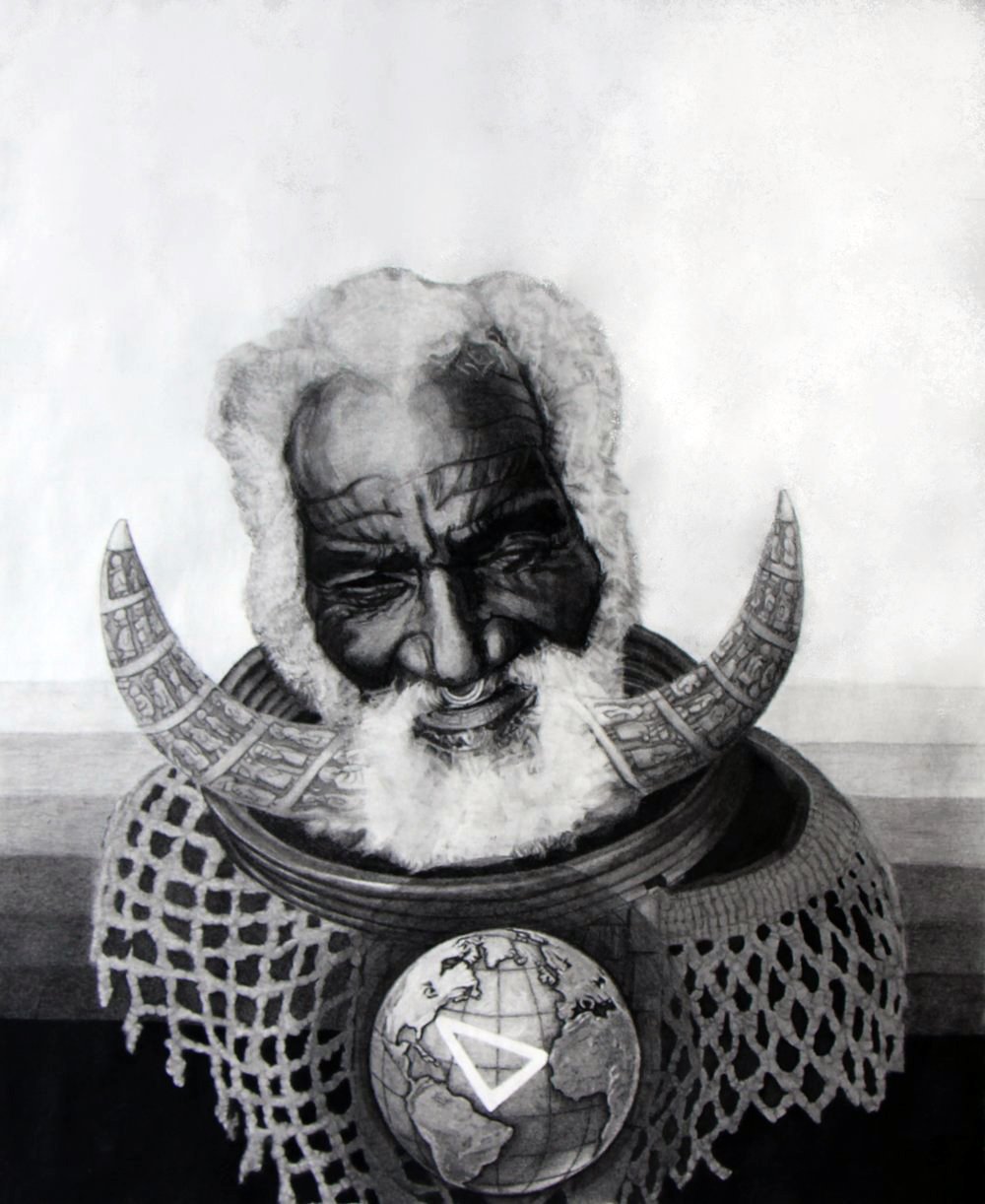
Neville Barbour II, “My God Has Horns Too,” 2020
“I wonder if we who are older think about the music in relation to the people who made it because we know/experienced them or did so with some kind of proximity. But what’s weird is that now we’re in charge of passing this information forward to people younger than us, so you have a lot of agency in shaping that experience.” - Dr. Kwami Coleman (2026)
It was on August 14th of 2024, just shy of my 44th Born Day, that I was taking a stroll from Long Island City (Queens) to Greenpoint (Brooklyn). I’d just come from MoMA PS1 or Trader Joe’s or someplace like that, and I’d decided to peruse the circuit of record shops in the heavily gentrified Polish neighborhood. After crossing the Pulaski Bridge, I turned right onto a small side street, where about halfway down the block, I came upon a small house with a few boxes of records between the garbage cans and the stoop.[1]
Frank Sinatra, Bobby Darin, Bert Kaempfert, and some other stuff typical of the neighborhood’s aging demographic filled the majority of the boxes. By the middle of the second box, I flipped over a visually familiar cover but assumed it was an 1980s reissue, so I decided to do a reverse flip just to make sure... and thank goodness I did. My fingers carefully gripped the cover by the tip of the upper spine, and I responsibly pulled it out of the water-damaged box, clearly marked in the minds of the homeowners as trash. The black & white photo of a beautifully bearded young Sonny Rollins was splattered with orange and gray shading and read “with the Modern Jazz Quartet, Art Blakey, and Kenny Drew.” While my heart didn’t exactly skip a beat… I remembered that Allah loved me, and I got away from that house as fast as possible before these folk changed their minds about what is and is not… trash.
Regarding his full-length discography, Sonny Rollins with The Modern Jazz Quartet (Prestige, 1956) is a compilation of recordings made in 1951 and 1953 and serves as the tenor saxophonist’s first LP as a leader.[2] Before this free.99 find, I’d owned a few records by Rollins but hadn’t dug much into his discography for a few reasons. For starters, the man has a large catalogue. However, over the years, I found much of it to be… good. Some might even say… predictable. Listen, Sonny played with the best of the best in the beginning. Bird, Miles, McLean, etc. Yet, he moved at a different pace regarding his execution. If anything, Sonny was a disciplined master, taking his craft seriously and rarely following trends just for the sake of it. In recent weeks I’ve spoken to a few other collectors and music historians, and we all agreed that his recorded output did not always match his legendary playing status. There are plenty of good records in his discography, yet many of them might not scratch the itch of all listeners.[3] With that said, I wanted to take a few moments to highlight a few of Sonny’s most important leadership moments, presented here in order of my discovery of them.
Newk’s Time (Blue Note, 1959)
I was one of the several managers at Baltimore’s The Sound Garden upon first hearing the RVG CD reissue of Sonny’s Newk’s Time featuring Wynton Kelly on piano, Doug Watkins on bass, and Philly Joe Jones on drums. I was immediately moved by his version of “Tune Up” (credited to singer Eddie Vinson and/ or Miles Davis, depending on the day) and the simmering motion of “Asiatic Raes” (better known as “Lotus Blossom” by my birthday twin trumpeter Kenny Dorham).
However, the real standout piece is the quartet’s take on the old Rodgers and Hammerstein piece “The Surrey with the Fringe on Top” (from their 1943 Broadway hit Oklahoma!). It opens with a crashing shuffle by Jones, with Sonny jumping in to state the first verse, then going into an amazing solo for much of the tune. Due to its performance in a duet setting (unique for that late-1950s), I can’t hear this without thinking of John Coltrane and Rashid Ali’s Interstellar Space(Impulse!) recorded in 1967.
Newk’s Time works as a great introduction to Sonny’s expansive catalogue and is a great example of the classic Blue Note experience (vast in its own right). The cool blue, presumably Reid Miles, cover design, Francis Wolff’s photo with the saxophonist in those iconic shades, the established Kelly and Jones, and the uncomplicated nature of the tunes make it easily accessible for new listeners and veteran collectors alike.
Freedom Suite(Riverside, 1958)
I don’t remember where I was when I first heard Freedom Suite. However, it remains most prized in my collection, and I believe it to be Sonny Rollins’ greatest LP. I’d read Charles Mingus’ Beneath the Underdog (1971), which makes references to bassist Oscar Pettiford, and I knew drummer Max Roach as a Bebop founder. Yet, this record expanded my musical knowledge by introducing both members of the rhythm section as masters to be explored individually.
The almost 20-minute workout suite takes up all of Side A (composed by Sonny), ranging from contemplative and balladry to unexpected jackrabbit pacing and back again. Side B is a range of standards that balance the musical variety displayed on the first half of the record (the swinging “Someday I’ll Find You” composed by Noël Coward being a highlight). The mixture of the two is subtle, creating an intentional, but not over-the-top political and cultural experience, similar to that of Abbey Lincoln’s Abbey is Blue (Riverside, 1959).[4]
Like that of Nikki Giovanni’s poem “Seduction” (1970), this album evokes a deep sense of love and intimacy, against the backdrop of violence inflicted on Black folk in America. Sonny explains in the album’s liner notes:
“America is deeply rooted in Negro culture: its colloquialisms, its humor, its music. How ironic that the Negro, who more than any other people can claim America’s culture as his own, is being persecuted and repressed, that the Negro, who has exemplified the humanities in his very existence, is being rewarded with inhumanity.” (Rollins, 1958)
The importance of this music and Sonny’s quote aligned together on a single project should not be understated, as it represents one of the earliest examples of Black Liberation Music. In the 1950s, Roach co-ran Debut Records with Celia and Charles Mingus, documenting Black artists taking control of their creations. Works by writers Langston Hughes (and later with Sterling Brown) were being recorded and published by Folkways Records. And before there were Strata East and Black Jazz releases, there was Freedom Suite, and the album should be acknowledged for its musical complexity and its intentional messaging from and to Black folk.
Way Out West(Contemporary, 1957)
I’d always thought the album cover for Way Out West was funny, but too gimmicky to be taken seriously, and therefore never gave it a proper listen.[5] There was no way this album would move me. But in 2026, I can say I was wrong, and it’s one of the most important records in American history. A recent acquisition for my collection, age has taught me to reevaluate what I thought of as disposable and plain unimportant in my younger years.[6]
It is important to highlight that Way Out West is Sonny’s first record featuring a piano-less trio and features bassist Ray Brown and drummer Shelly Manne. The “strolling” school, of which the tenor saxophonist is undoubtedly the founder, allows him to concentrate on playing without getting boxed in by the traditional chords of whatever composition he’s improvising around. While this has become a standard practice at the time of this writing, one needs to understand how revolutionary it was in 1957.
If anything, this record might represent the first step towards the music associated with the name Free Jazz. I’d even argue, if it has not been written before (which it probably has been, so I might be late to the party), that these sessions could have inspired a young Ornette Coleman to abandon the piano after his debut LP, 1958’s Something Else!!!! (Contemporary). Coleman, along with trumpeter Don Cherry (who’d later record with Rollins and many avant-garde luminaries), bassists Red Mitchell and Percy Heath (of the Modern Jazz Quartet), and drummer Shelly Manne (who later criticized poet Jayne Cortez and Ornette’s son Denardo Coleman’s drumming on the father’s 1966 Blue Note masterpiece The Empty Foxhole), would step into the studio approximately two years later and record Tomorrow Is the Question! (Contemporary, 1959). While this LP is a bit more adventurous than its predecessor, it is no match for Coleman’s follow-up record only a few short months later.
The Shape of Jazz to Come (Atlantic, 1959) is considered to be Ornette’s proper “arrival.” With it, he, Don Cherry, bassist Charlie Haden, and drummer Smilin’ Billy Higgins (who’d go on to be a pillar in the Black Liberation Music realm, along with a mainstay for many releases on Strata East) broke new ground in terms of musical freedom. Now, while I do not have any concrete proof of anything typed out in the last few paragraphs, I believe that it is safe to say:
The West Coast connection (especially via the Contemporary Records affiliation)
The timing of said releases
The exploratory nature of Sonny’s ideas and his commitment to recording in the trio format
... give a strong argument as to why Way Out West is Sonny’s first watershed moment, and potentially his greatest musical contribution to a wider Black creative musical audience, being that his idea of freedom and tradition-breaking inspired so many others that came after him. His name is typically not associated with the avant-garde, but that should definitely change.
The Sonset
I didn’t feel sad when Sonny Rollins (aged 95) passed away on May 25th, 2026. In fact, I felt a bit happy, especially since it was saxophonist and The Arkestra leader Marshall Allen’s Born Day (and Sonny’s elder by 7 earth years). Quietly, while thinking of this essay I was invited to compose, I have celebrated these Black men having the opportunity to grow old. As someone who has lost 3 (at the time of this writing, almost 4) older brothers, both biological and step-fathers, all grandfathers, 1 uncle, and 2 nephews, I look to these elders for guidance on how to get... there. Sonny’s life was not without struggle, and he did not demand his music to reflect where he’d been, but more so who he was and where he desired to go. Ninety-five years old is a long time to learn a craft, develop a sense of discipline, stumble, fall, and get back up to resume your position. If one follows his discography, it clearly shows he decided early on to move at his own pace, as opposed to being bogged down by the trajectory of others. And now he has entered the final realm of the masters... and all masters need and deserve rest. If there is anything to take away from his lengthy stay on this planet, it is that discipline is a virtue and all time should be spent wisely.
ʾinnā li-llāhi wa-ʾinnā ʾilayhi rājiʿūn
Gabriel Jermaine Vanlandingham-Dunn
(Brooklyn, New York, June 2026)
Notes
[1] I don’t typically stop and flip through records so close to trash cans. My mother did, in fact, raise me right.
[2] The Modern Jazz Quartet was the longest running group in the history of this music. Established in 1952 and running, minus a few breaks and lineup changes, until the late 1990s. They’re, along with De La Soul and Gang Starr, my favorite group of all time.
[3] Like all things in life, this too could change as listeners mature and grow.
[4] It should be noted that Wynton Kelly, Philly Joe Jones, and Max Roach (Lincoln’s onetime husband) all participated in the sessions for Abbey Is Blue.
[5] Photography icon William Claxton shot the photo in the desert, and apparently the concept was completely Sonny’s idea so... egg on my face I suppose.
[6] Please keep in mind that I’ve been collecting records since 1985.
Gabriel Jermaine Vanlandingham-Dunn is a music historian, DJ, professional listener, and writer. Most recently he contributed the foreward to Dr. Cisco Bradley's fourth book I Hear Freedom: The Great Migration, Free Jazz, and Black Power (Columbia University Press, 2026). He currently resides in Brooklyn, New York.


