
What Goes Around Comes Around: On Reading the World and Hearing the Word
by CHRISTOPHER R. ROGERS
in Fall 2025
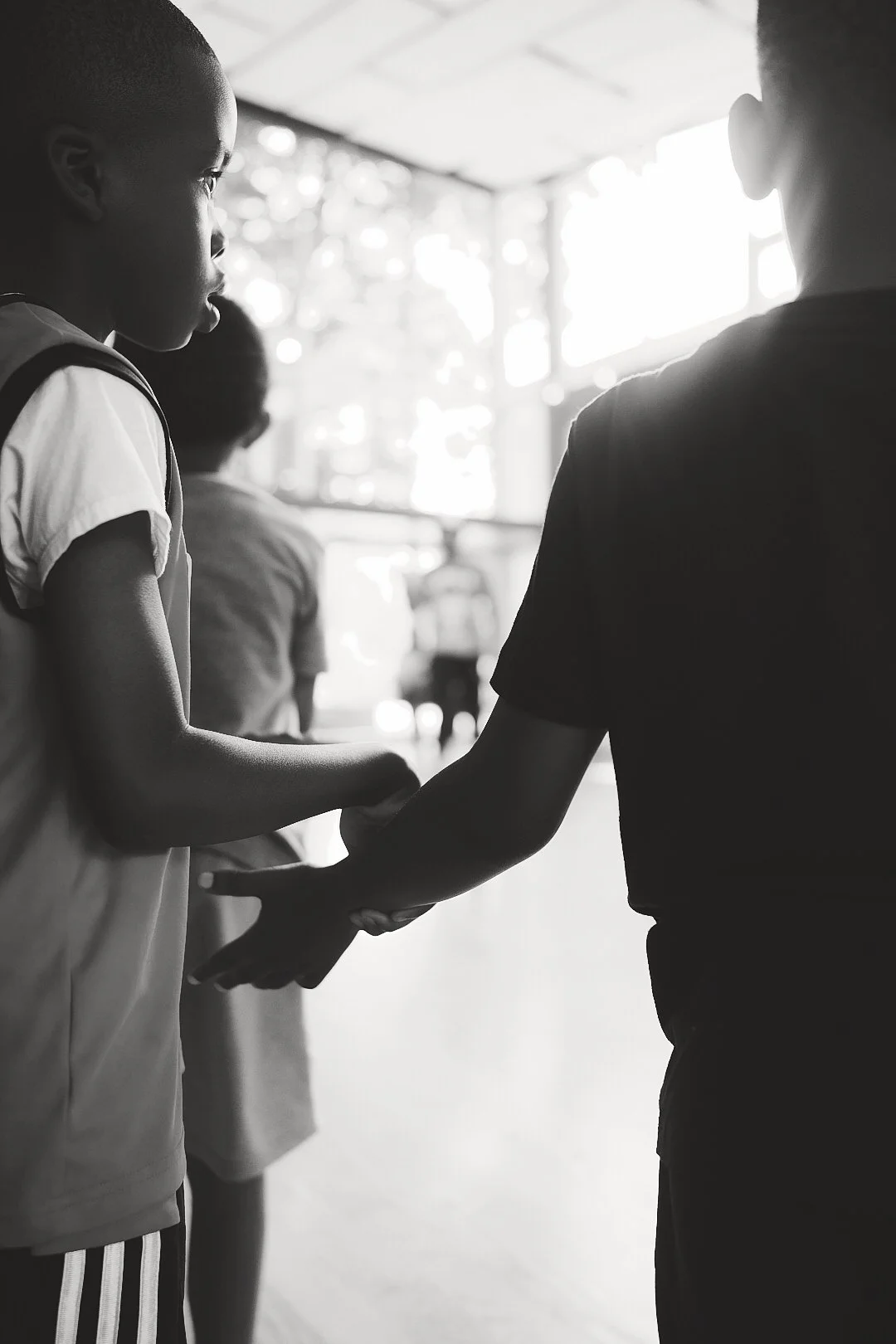
Tafari Melisizwe, “We Got Us,” 2024
It was in language that the slave was perhaps most successfully imprisoned by his master; and it was in his (mis-)use of it that he perhaps most effectively rebelled. Within the folk tradition, language was (and is) a creative act in itself; the word was held to contain a secret power…
—Kamau Braithwaite (Quoted in Mackey, an Interview with Kamau Brathwaite, p.15)
The year was 1998. Ms. Lunsford, my 4th grade teacher, stapled a note to my shirt to make sure it made my home for my schoolteacher mother Beverly Box-Rogers. The note relayed a transcription of a direct quote, of which I had already admittedly affirmed to be fully true: “I hate reading.”
Yup, my 4th grade teacher Ms. Lunsford, a very cute recent graduate from my mother’s alma mater Cheyney State, must have really believed she was Janine Teagues coming to save the day from my confessed backwardness. In truth, she was only accelerating my promised demise by the time Moms arrived home from her own afterschool duties at neighboring Wetherill Elementary, where she would find me with that note at our 16th Street home while my siblings chuckled and pointed from the sideline couch cushions. Readers of this essay should know I would go on to collect many more mild beatings for all sorts of unmerited situations that, with further reflection, mostly speak to my early adolescent inclinations to honest reporting. A stronger commitment to lying, sorry, telling a story, would have saved my ass plentytimes.
I hate reading. Yet, I can maintain that at the time a parallel truth that by traditional American metrics I was the best reader in my class. This is not egotistical conjecture—I can provide you with the working phone numbers of some of my 4th grade classmates to testify to it. Teachers too. Everybody at Chester-Upland’s Stetser Elementary on 17th & Melrose Avenue in 1998 knew me, my mother’s son with thick lenses and crooked glasses—they knew I didn’t have a problem with eyeing words. I knew how to read. I knew I was good at it. I hate reading was not me signaling a struggle with the decoding process. I hate reading was my treatise on educational philosophy and state-sponsored human development. A cutting commentary from a 10-year-old Black boy and son of a veteran schoolteacher noting what Ms. Lunsford’s ad-hoc reading assignments entailed for me.
The more I think: That’s probably what got me the whooping. Not the “I hate reading” part, but speaking my piece all loud, noisy, and out of turn, not knowing which notes not to play, not trusting the creative process of a fellow young Black woman educator trying to wrangle together an overpacked and under-resourced classroom of Chester’s future. My Chester High African-American History teacher Ms. Beverly who once kicked me out of class, yup, she would later story, “He just too damn smart for his own good.” She remains right.
My mom provided correction, yet I continued elusively in search of understanding. For me, reading was teacher-produced busy work, a constant keep 'em running at all times directive to “go find something to do” narrowly fulfilled by sending me on an isolated journey through the makeshift Title 1 canon of all that was available in our more-underfunded-than-underperforming school district. Reading, in my memory of that time, had very little to do with the transformative, improvisatory experience of feeling, thinking, sentipensar-ing the world through the word. Certainly, not any world that mirrored my reality of being a 10-year-old Black boy growing up in the toxic whirlwind of Chester, PA in the mid-to-late 1990s.
I said it. I meant it. I hate reading. My attention, my dreams, and my people weren’t in them books I was forced to spend time with because an overtaxed Ms. Lunsford was running out of differentiated instruction strategies.
Confessional Note #1: Yes, CUSD certainly had the 100-book challenge just like yours did. I took the cue from my older brother Charles and we cheated the entire jawn. I just wrote down the books that my mom had around the house. No reading was necessary. We were still all going to get our free Pizza Hut personal pan. Did Mom know that we cheated the honor code? Did it matter? It was free dinner for her kids, this Black somewhat-single mother of four attempting to make it all happen on one unionized teacher salary.
Confessional Note #2: Let’s be honest: If I was white, I would’ve got so much more validation for being able to quickly recognize and quickly exploit the cracks in the system. I’ve since learned to never wait for handclaps.
A fitting biography if you ask me, Ralph Ellison once described what these children are like, like this:
Sanity suggests that the street child learns that which prepares him to live in a world that is immediate and real. To fail to recognize this is to expect far too much of a human being while crediting him with far too little humanity. Thus we must recognize that the children in question are not so much “culturally deprived” as products of a different cultural complex.
confessional note three: This is totally a metaphor. I’m far from an actual “street child.” My 4th grade classmates will also tell you this without you even asking. I required paraprofessional cousins to survive my city.
Digging deeper with Ellison, I hated reading because the reading I was being asked to perform for compliance was not immediately helpful for a 4th grade Black boy in navigating how I had to deal with my environment, because reading was not a real representation of what I made of what is abiding in [my environment], because reading was not what I believed was necessary to find my way through [my environment], because reading was not what revealed and welcomed me to feel at home in the world.
Another brother-educator David Llorens spoke it this way during the Black Arts Movement, during that special time when Ellison couldn’t get over himself:
I am suggesting that while the remark “English ain’t relevant” may appear, on the surface, to be without substance, or maybe even crude, it actually is a remark which upon investigation raises fundamental questions about American society. To dismiss such a remark as wrongheaded is to ignore the likelihood that the makers of the remark know something about this America that is yet incomprehensible to others of us. (p. 210)
I hated reading. I surmise now what lived behind the word reading was a whole colonially-drenched arrangement of practices, procedures, and policies that presupposed what kind of reader, which is to say what kind of individual, what kind of being human, my public school education incentivized for me to become. I might have learned just last year that my silly impulse to actually say out loud I hate reading could have been a flash of the spirit of my soul-freeing deciphering practice surfacing itself at the right wrong time. It became a blueprint too, a gift and a curse for what my life would become all about. Rap music. Black poetry.
***
I used to say that I learned to write by listening to people talk. I still feel that the best of my writing comes from having heard rather than having read. This isn’t to say that reading doesn’t enrich or that reading isn’t important, but I’m talking about foundations…my first stories were heard stories—from grown-up people talking. So I’ve always heard stories of people generations older than me. I think that’s important. I think that’s the important thing.
—Gayl Jones, “Gayl Jones: An Interview”, (p.692)
You see, I hated reading, but I loved listening. I loved the feel, the emphasis on feeling, reflective of what my ol’ uncle Ralph terms as a blues approach to life. Uncle Jimmy too. He said the uses of the blues give us grounding, provide revelation, speak to the possibility of transcendence. I was deep into rap, deep into the Black quotidian capacity to manipulate language, deep into probing the virtuosity of music and the poetry of words, deep into clinging to that which was real to me. I couldn’t be kept from the multidimensional realities revealed to me between the radio dial, music video shows, and them rare happy times I was allowed to ride around unsupervised in the back of the car with my cousins and their tape decks. This crack music was my fix; being surrounded by these true Black blues had me just below the heavens.
I was so listener-deep into rap music that at the same damn time that Ms. Lunsford had stapled a note to my shirt, my older brother Charles and I had already conspired to build our very own binder of rap lyrics we subversively printed every chance we got from OHHLA.com. The Original Hip-Hop Lyrics Archive, a legendary website made up of .txt files that transcribed our favorite rap songs weekly. Ones we knew and ones we didn’t. OHHLA was way before RapGenius and wasn’t a matter of suburban weirdos trying to surveil Black speech. On this dial-up internet friendly site, you, the dedicated hip-hop listener and Black elementary school student could choose your favorite artist and click through their album tracklist. Wait til Mom’s not home and send those .txt files to the printer. Borrow Mom’s three-hole punch and sort it into the binder, by artist, by album. Might have been about 200 pages at one point. I mean, we would all eventually go printer crazy like every child who was allowed unlimited school library printing heading into 99’ and 2000. Print it all. Just print it all like its cash money. The block was hot.
I’m saying I was a ten-year-old semi-sheltered Chester kid and yet grown man rap aficionado, printing out rap lyrics as if I have any sort of street sense to understand what the hell they were even really talking about. Their words were intoxicating: the flexibility, the nonchalance, the timing, the flow, the ambition, the casual innovation, the braggadocio attitude, the unceasing hustle. I didn’t always know the word, but the worlds felt right. A notable quotable could feel like you were being let in on a secret of survival they only earned through conquering chaos and rendering the impossible feat commonplace. These magicians made a way with words. They invented otherwise through divine speech. They were all making a dollar out of 15 cents like see, the money ain’t a thang.
Some of these lyric .txt files could even take you to fully unfiltered funk: Lil’ Kim’s “All About the Benjamins” verse went well beyond the ones I had already memorized from the music video. She said it all in those bold and bee-stinging lyrics. I couldn’t just listen with my ears, my body heard it all too. She showcased a Black mastery of the art of cussin’ to reveal a dynamic and dynamite experiential language that felt illicit in close comparison to the muted worlds featured in an upper elementary public school classroom library. It stung me. It raised in my bodymind that words could mean what we wanted them to mean. They evidenced that language was really ours to claim and mold to the shape of our lives. And it might then just all come up, show, and explode with DJ Cosmic Kev and Q-Deezy on a Power99 Friday night.
Returning to my brother David Llorens, he overstood:
The Black student knows that until quite recently the word motherfucker would have frightened most white teachers out of the classroom, and one suspects that it still holds the power to make a sizable majority uncomfortable. It happens, however, to be a word that in Black possession can be an obscene curse or the most splendid of praises. When, for instance, Lew Alcindor [Kareem Abdul-Jabbar] floats with the grace of a Nureyev over three other giants and stuffs that pill through the net, he would not expect that the “brothers” who are cheering him on should call him anything less than “a bad muthafucka.” And all the white folks in the world saying “Isn’t he terrific” or “Gee whiz, he’s great” simply do not—if you can dig it—measure up. (p. 212)
I loved rap music for its cunning, for its double-daring, for its commitment to tellin’ it like it is. My bathtubs lift up. My walls do a 360. We got the shit that the government got. I was a ten-year-old star-student and undoubtedly more interested in being/becoming a bad muthafucka. Rap was full of bad muthafuckas. Reading The Outsiders was cool, but these were the real heroes outside. Because they knew what I didn’t, what I struggled mightily through life to grasp. They knew what it took to navigate these rough tumultuous clashing waters of Black life in America and make it out the storm, of course wet, but still resolved, still with a shred of your integrity and vision intact. They got it together grindin’. They kept it pushin’. They remained forever on the run, sorry I mean on the one.
Reading unclothed was a Black child left behind to compliance culture. Reading served as a submission to the rat race. Reading was what you were supposed to perform to survive school, but never did it add up to exactly real life round here. Reading reminded me of what Uncle Aime Césaire once called that ol’ Antillean unease. It was the master narrative of this kind of state-mandated education that we were all sequestered in. We could never be the main victorious protagonists of these stories performed at the center of our city’s schooling. We were rather scripted to be mere accessories to the word and worlds that defined those landscapes. Reading was serving a prison sentence in their world until the bell rang, until the let-out, until you made it out of range of their canons. Rap was reclaiming our time and ourselves from the master’s clock.
I don’t know. I was ten. But I think I knew even then I wanted to do more than survive; I knew I felt I wanted to make a statement like these brothers I heard through these speakers. In this 3-inch binder archive my brother and I created and hid from my committed Baptist mother, I was remixing street dreams and mastering the tracks of Black boys turned men who had seemed to maintain all the aggressiveness, daring, and ghostnotes of deliverance that I was told in church pews would assuredly lead to my premature death. It was so obvious to me that they were more than alive, they were thriving; it was evidenced by their chains and whips. I too wanted a Jacob. I too wanted a CL600, with 20-inch rims and five-percent tints. The allure of freedom was beginning to fit a Bentley Azure.
Reminder: I said it a couple times already, but I was a ten-year-old working-class Black boy in the late 90s with cable television, mostly thanks to my pops knowing his way around a RadioShack. We never could afford the premium package. We yearned for those luxury channels and new jewels not knowing we could become them ourselves.
Them books I had to read in they schools was child’s play. I had higher goals for myself. I was plotting to be the man in these streets. In recovering these rap lyrics and lost tapes, I was going to be a timeless wonder. It was written for me to be Illmatic. It was written that the world was mine.
This crack music I had to hide inside my home provided an underground resolve against all those petty annoyances I was burdened with. I learned that other people’s bullshit wasn't something I had to simply swallow and submit to no more. There were other ways of relating and responding, more assertive, subversive, authentic, and grounded in a lineage that felt closer to home, closer to a tangible dream of a more beautyful world that honored my true existence. In the world of rap, you could straighten your back, seize your moment of truth, spit your set in open yet coded language, and stand your ground. Claim your spot. Write yourself into history. Write yourself into a freedom they said would never be possible. Nevertheless, you could get into that booth and through the formless night say hello to a new world all your own. Stay on the one and your life could become a classic record. These were the good ol’ days before I found out Industry Rule #4080.
Dionne Brand wrote:
We were trained to read the books, but not to understand the words and their larger contexts. And of course, again, who is “we”? I think of my university years, for example, as years of sitting in someone else’s elisions, someone else’s design for the world. An uncomfortable body shifting in its seat, being absorbed into, and absorbing, the toxins of the readings, yet alert to the world in another life. (p. 60)
I hated reading, because like Dionne Brand just spit, I was shifting in my seat in Ms. Lunsford’s 4th Grade class at Stetser Elementary, salvaging a flash of the spirit that flared up the kind of reader I feared to not become. These words Dionne published just last year, where in another stillmatic track of what goes around comes around, I could be found in university classrooms teaching other people’s children how to read.
To those who care to keep reading…
Kamau Braithwaite, Folk Culture of the Slaves in Jamaica (New Beacon, 1970)
Dionne Brand, Salvage: Readings from the Wreck (FSG, 2024)
Ralph Ellison, “What These Children Are Like” in Going to the Territory (1986)
Gayl Jones, “Gayl Jones: An Interview” The Massachusetts Review (Winter 1977)
David Llorens, “What Good the Word without the Wisdom? Or ‘English Ain't Relevant’ What is English Without the Word” College Composition and Communication (October 1971)
Richard Wright, “Memories of my Grandmother” (Library of America, 2021)
Christopher R. Rogers, Ph.D started We Win from Within in June 2023 as an educator and cultural worker from Chester, PA with more than a decade of experience in supporting justice-oriented arts, culture, and community in the Greater Philadelphia area. He currently co-coordinates the Friends of The Tanner House, incubating a revitalized Henry Ossawa Tanner House at the intersection of Black heritage preservation and community cultural organizing. As a Facilitator with the W.E.B. Du Bois Movement School for Abolition & Reconstruction, he supports aspiring movement leaders serving communities most impacted by poverty, policing, and mass incarceration. He’s previously co-edited How We Stay Free: Notes on a Black Uprising (Common Notions, 2022) with novelist Fajr Muhammad and anticipates the release of his My City Need Something portraits and prose collaboration with photographer Karim Brown (Common Notions, 2026).


